Resource efficiency in the food industry
How to reduce waste and improve the use of water, energy and raw materials across operation

Kısaca
- Data transparency and precise measurements make it possible to identify and reduce losses of water, energy and raw materials in a targeted manner.
- Optimized production processes lead to savings in water, energy and raw materials to support water conservation and energy efficiency.
- Stable, automated processes with real-time monitoring reduce fluctuations, waste and the production of non-conforming products, resulting in improved yield and reliability.


Why resource efficiency matters
Resource efficiency is the most immediate and effective lever for improving sustainability in food production. Every cubic meter of water, kilowatt‑hour of energy and kilogram of raw material saved reduces cost, emissions and risk. It also supports water conservation, reduces food waste, and advances overall resource conservation. Resource efficiency reflects how well production processes are understood, designed and monitored.
Water efficiency across processing and cleaning

Optimized cleaning enables energy efficiency, water conservation and reduced cleaning agent usage.
Water plays a dual role in food production: first, as a direct medium for processing products, and second, as a vital resource for cleaning. Its efficient use is therefore a top operational priority for water conservation and reducing water consumption. The following measures offer excellent potential for water conservation:
- Well-designed CIP systems that coordinate time, temperature, flow rate, and chemical concentration to achieve effective cleaning without waste. It is equally important to avoid over-cleaning by adjusting the cleaning intensity to the actual hygiene risk rather than applying conservative standard values.
- Where regulations permit, the recirculation or reuse of water can further reduce the demand for fresh water. Under defined conditions the following processes can support this approach: final rinse water from CIP, water from indirect cooling or heat exchangers, condensate from evaporation or drying.
- Targeted process control helps minimize wastewater volumes and organic load (COD, BOD), which reduces the burden on downstream wastewater treatment and supports the overall efficiency of the plant and broader resource conservation.
Mass and energy balance as the starting point

Capture accuracy where it matters most: at raw milk reception. Proline Promass Q eliminated measurement error at the point of highest gas entrainment
Mass and energy balance optimization starts at raw material reception and continues through every process step, from preparation and processing to packaging and utilities. Understanding what enters the plant, what is transformed, what leaves as product and what is lost along the way is fundamental to improving efficiency.
The objective is to reduce water, energy and raw material input per ton of product by systematically identifying losses caused by evaporation, leaks, purge streams and inefficiencies during startups and shutdowns. Including raw material reception in the balance helps uncover early losses due to over‑delivery, spillage, dilution or inconsistent quality, which directly affect yield downstream. A clear, end‑to‑end balance makes yield losses and off‑spec production visible and quantifiable, turning assumptions into engineering facts.
At the same time, optimizing the balance between thermal and mechanical energy use helps avoid unnecessary energy conversion losses. The guiding question remains simple but critical: where are resources being lost and why? Answering this question provides the technical foundation for sustainable and measurable process improvements.
Energy‑efficient production processes

Efficient on-site energy monitoring at a large dairy company in northern Germany
Many food processing operations are inherently energy-intensive, which is why systematic energy management is a central focus of process engineering. Manufacturers therefore focus on avoiding unnecessary heating, cooling and phase changes while actively integrating and recovering heat between process steps to reduce overall energy consumption.
The choice of technology also plays a decisive role, for example by using energy-efficient separation methods such as membranes instead of purely thermal processes wherever possible. Equally important is the precise alignment of process conditions with actual product requirements to avoid conservative setpoints that lead to excessive energy consumption. Energy efficiency is typically measured by using clear, comparable metrics such as kilowatt-hours or steam consumption per kilogram of product, which provides a fact-based foundation for continuous improvement and reporting.
Process stability and automation

Measurement and automation technology ensures transparency and stability in food processing, enabling consistent quality while reducing resource consumption.
Process stability and automation are key enablers of resource efficiency in food production, because stable processes inherently consume less water, energy and raw materials. Tight control of critical parameters such as temperature, flow, pressure, pH and concentration reduces variability and prevents unnecessary overprocessing.
Early detection of deviations, fouling or buildup allows corrective action before problems escalate into downtime or product loss. By relying on real-time inline monitoring rather than manual sampling, operators gain continuous visibility into process performance and can prevent off‑spec production. The result is a more robust operation with less waste, lower energy and water consumption and higher yield.
Reduction of product losses and waste

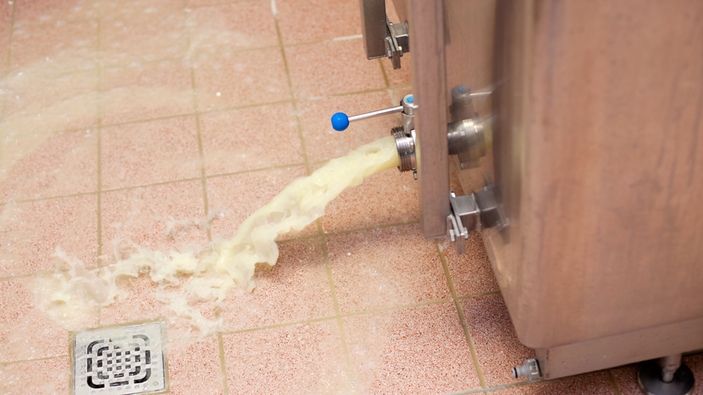
Waste prevention starts with understanding where waste comes from - visible losses indicate inefficiencies that can be eliminated.
In food production, product losses and food waste are clear signs that part of the process is not running as efficiently as it could. Reducing waste begins with minimizing losses during startup, shutdown, and batch changes, when valuable product is often unnecessarily discarded.
Well-designed processes also help prevent contamination, clogging, and biofilm formation, which can lead to yield losses or unplanned cleanouts. Gentle process conditions protect product quality and yield, while clean separation and thoughtful utilization of byproducts transform potential waste streams into usable resources and reduce food waste. The underlying mindset is simple and pragmatic: waste is avoidable if you get to the root of the exact cause.
Measurement first and improve with confidence

Turning process data into insights: precise measurement and digital data visibility enable efficient food production.
Measurements and data transparency are fundamental to true efficiency, as improvements are based on reliable, verifiable data rather than assumptions. In the context of digitalization and smart manufacturing, this data forms the backbone for connecting field instrumentation with higher-level systems, enabling consistent and traceable decision-making across the entire operation.
Accurate tracking of energy and material consumption provides the factual basis for decision-making, while real-time inline measurement replaces estimates and guesswork with real-time insights.
Clear transparency into resource consumption at every process step reveals losses and inefficiencies. Clearly defined KPIs enable continuous improvement as well as consistent internal and external reporting. The core principle is simple and has proven itself in industrial practice: What cannot be measured cannot be optimized - and what is optimized contributes to resource conservation.